

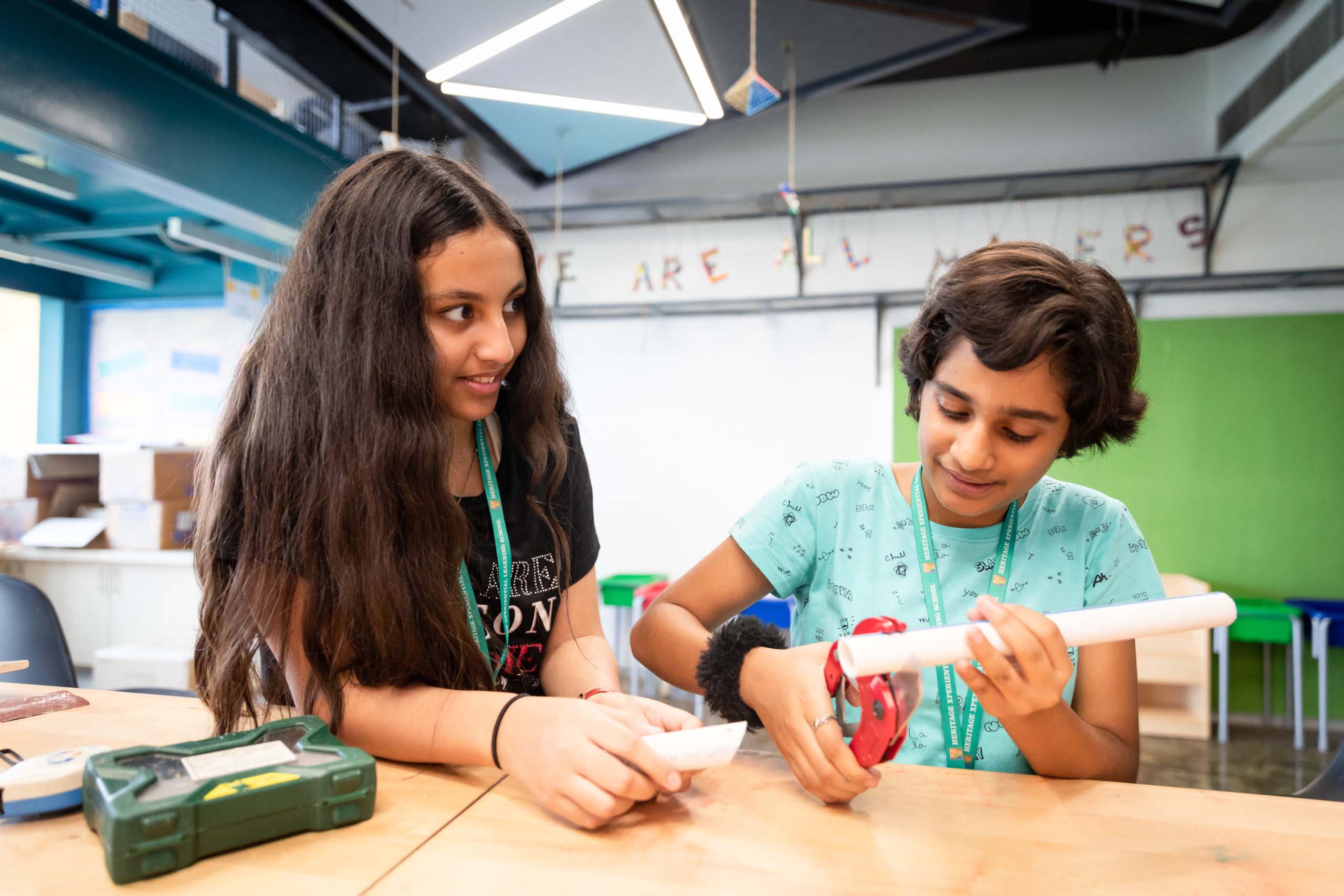
Ask a child what they did at school today, and you will usually get one of two answers. Either a shrug and “nothing much” – or a twenty-minute conversation that starts with something they built, a disagreement they had with a classmate about how to solve a problem, a question their teacher asked that they are still turning over.
HIXS parents tend to get the second kind of answer. That is not a coincidence.
Heritage International Xperiential School in Gurgaon has built its entire approach to education around a straightforward but genuinely radical idea – that children do not learn best by being told things. They learn best by doing things, struggling with things, getting things wrong and working out why, and then trying again with that understanding built in. As one of the IB schools in Gurgaon that places experience at the very centre of learning, HIXS does not treat experiential education as an add-on. It is the architecture.
This is what experiential learning at HIXS actually means. Not the occasional science experiment or a field trip once a term. The entire school – from how classrooms are designed to how the timetable is structured to how teachers are trained – is organised around putting experience at the centre of the learning process.
What Experiential Learning Actually Means at HIXS
The phrase gets used loosely in education marketing. It is worth being precise about what it means here specifically.
A student at HIXS does not sit through a lesson on water conservation and then answer questions about it. They might design and run their own investigation into local water usage, present their findings to a real audience, and then reflect on what the process revealed – about the problem and about themselves as learners. The subject knowledge is still there. The critical thinking, the communication, the ability to manage a complex task over time – those are built in alongside it, not treated as separate skills for a different day.
This is what the school’s name points to. The X in Xperiential is not a stylistic choice. It is a commitment. Every programme, every assessment, every classroom conversation is designed around one question: what is the student actually doing here, and does it mean something?
The IB School Syllabus at HIXS is structured around exactly that question. Unlike a conventional curriculum that separates knowledge from its application, schools with IB curriculum build understanding through inquiry – asking students to engage with ideas in context rather than in isolation.
The Campus as an Argument About Learning
Walk around the HIXS campus and the philosophy becomes physical. The spaces are not arranged for a teacher to stand at the front and deliver. Maker spaces sit alongside science labs. Outdoor learning environments connect to indoor studios. Performance spaces open onto areas where students can work independently or in groups.
The school’s thinking about space as the third teacher is not decorative – it is structural. Children move between these spaces based on what the learning demands that day, not based on a rigid timetable that treats every subject as an island.
Among IB Board Schools in Gurgaon, very few have designed their physical environment with this level of intentionality. At HIXS, the building is part of the curriculum.
Learning Beyond the Classroom
Some of the most significant learning at HIXS happens entirely outside the building.
The school runs expeditions – real ones, with genuine purpose and genuine challenge. Community engagement programmes connect students to contexts well beyond the school gates. Interdisciplinary projects pull together history, science, mathematics, and the arts around a single compelling question – because that is how interesting questions actually work. They do not respect subject boundaries.
What these experiences give students is something classroom instruction alone cannot: the experience of applying knowledge under real conditions, of working with people who see a problem differently, of hitting an obstacle no textbook prepared them for and having to think their way through it anyway.
Why It Works – and What Parents Notice
There is solid research behind all of this – decades of work in educational psychology showing that learning sticks when it involves active participation, when it carries emotional weight, when students are asked to reflect on what they did and why it worked or did not.
But the more compelling evidence, for families considering HIXS, is simpler than that.
Children who are learning experientially come home different. Not tired in the depleted, glazed way of a child who has sat through six hours of instruction. Tired in the way of someone who has actually used their brain – and still wants to talk about what happened. Still turning something over. Still curious.
That shift – from a child who reports what they were taught to a child who is genuinely thinking about what they encountered – is what HIXS parents mention most often when they are asked why they chose the school.
Among the Top IB Schools in Gurgaon, HIXS is distinctive because this philosophy runs through every year group, every subject, every room. The Top IB Schools understand that the habits of learning formed early are the ones that last. HIXS acts on that understanding from day one.
Frequently Asked Questions
Q1. What does experiential learning mean in practice at HIXS? At HIXS, students actively engage with real problems, design investigations, present findings, and reflect on the process – rather than passively receiving information. As one of the Best IB Schools in Gurgaon, HIXS has built this philosophy into the structure of the school day itself, not reserved for special project weeks.
Q2. How does the IB curriculum support experiential learning? The IB curriculum is built around inquiry, which aligns naturally with experiential learning. Students are asked to investigate, question, and connect ideas across disciplines – not simply absorb content. HIXS extends this through maker spaces, expeditions, and interdisciplinary projects.
Q3. Are there dedicated spaces for hands-on learning at HIXS? Yes. The HIXS campus includes maker spaces, science labs, outdoor learning environments, and performance areas – all designed around how students actually learn. The physical environment is treated as part of the curriculum, not just a backdrop.
Q4. Do students at HIXS still cover standard academic content? Completely. Experiential learning at HIXS deepens academic rigour rather than replacing it. Subject knowledge is embedded within real tasks and investigations, so students understand not just what to know but how to use it.
Q5. How can I begin the admission process at HIXS? Families interested in IB School Admission in Gurgaon can connect with the HIXS admissions team directly. They will walk you through each stage of IB School Admission and arrange a campus visit so you can see the learning environment for yourself.
Conclusion
Heritage International Xperiential School is not trying to be a slightly better version of a conventional school. It is trying to be a fundamentally different kind of place – one where learning is something students do, not something done to them.
If you are looking at IB schools in Gurgaon and want to understand what that difference looks like in practice, HIXS is the clearest answer available. Come and see the spaces. Talk to the students. Ask them what they did today. You will not get a shrug.


