

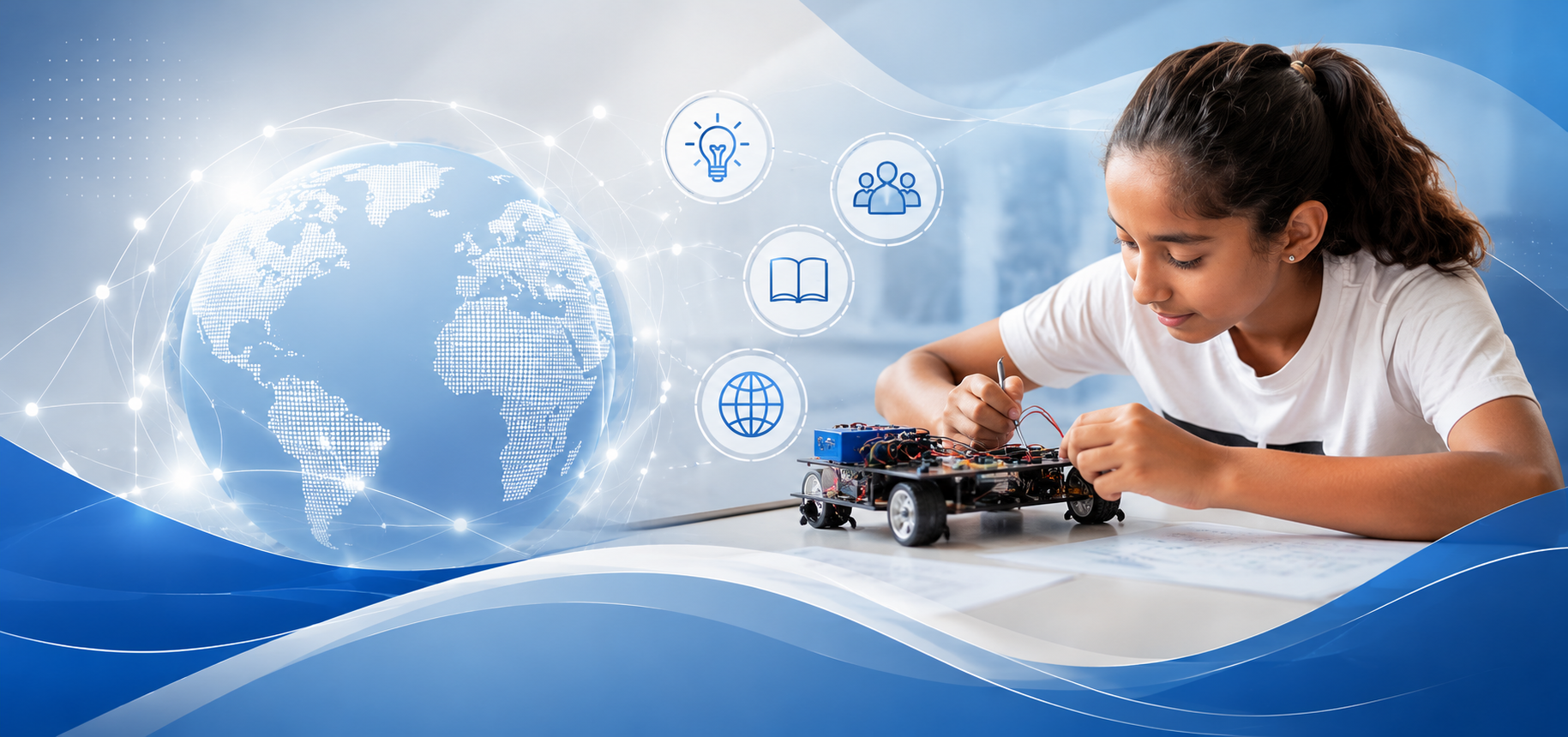
Ask any parent what they want most for their child’s education, and the answer is rarely just “good grades.” It is confidence. Curiosity. The ability to hold a conversation with someone from a completely different background and genuinely listen. It is the sense that their child will not just survive in the world, but understand it. This is precisely what draws so many families toward IB schools in the first place, and it is worth understanding why the framework works the way it does.
Inquiry Before Instruction
Most traditional curriculums begin with a syllabus and ask students to absorb it. The IB begins with a question and asks students to investigate. This single shift changes everything downstream. A student is not simply told what happened in history, they are asked to examine multiple perspectives on why it happened and what it means today. A science lesson is not just a set of facts to memorise, it is a problem to be tested, questioned, and understood from first principles.
This is inquiry based learning in practice, and it is the foundation of global thinking. A child who has spent years questioning rather than absorbing develops a habit of mind that does not switch off outside the classroom.
This habit is built earlier than most parents expect, often starting at the nursery stage itself. Understanding the school admission process for nursery is a useful first step for families who want their child’s global thinking foundations to begin from day one.
Learning Across Borders, Not Just About Them
Global thinking is often mistaken for simply knowing facts about other countries. The IB goes further. Through units like Theory of Knowledge in the Diploma Programme, students are asked to examine how knowledge itself is constructed, questioned, and understood differently across cultures. This is a subtle but powerful shift. It teaches a student to hold multiple viewpoints at once without discomfort, rather than defaulting to a single cultural lens.
Combined with language acquisition requirements and internationally benchmarked subject content, students in the IB Board Schools in Gurgaon and elsewhere are, by design, exposed to a wider frame of reference than a single national syllabus typically allows.
Real World Application, Not Theoretical Learning
The Middle Years Programme in particular is built to connect classroom learning to genuine real world contexts, whether that is a community project, an environmental study, or a piece of research grounded in a live issue rather than a textbook chapter. By the time students reach the Diploma, this habit has matured into the CAS portfolio, which requires creativity, activity, and service as a core part of graduation, not an extracurricular afterthought.
This is where global thinking stops being an abstract goal and becomes a lived skill. Students are not just learning about the world, they are practising engagement with it.
What This Looks Like at HIXS
At HIXS, this philosophy is delivered through what the school calls experiential learning, where expeditions, cross disciplinary projects, and structured reflection are built into the everyday rhythm of school life rather than treated as occasional events. The programme structure reflects this from the Primary Years level onward, ensuring the habits of global thinking are built early rather than introduced suddenly at the Diploma stage.
Families exploring what a globally minded education looks like in practice are welcome to visit and see this in the classroom, in student conversations, and in the projects on display around campus.
Frequently Asked Questions
Q1. Does global thinking mean less focus on academics? No. The IB is academically rigorous. Global thinking is developed alongside strong subject knowledge, not instead of it.
Q2. At what age does this kind of thinking start developing? From the Primary Years Programme onward. Inquiry based habits are introduced early and built on progressively through each stage of the IB continuum.
Q3. Is this approach only useful for students planning to study abroad? Not at all. Global thinking skills, adaptability, perspective taking, and independent reasoning, are valuable regardless of where a student eventually studies or works.
Q4. How is this different from simply teaching general knowledge about other countries? General knowledge is passive information. Global thinking as developed in the IB is an active skill, built through inquiry, reflection, and real engagement with ideas and communities.


