

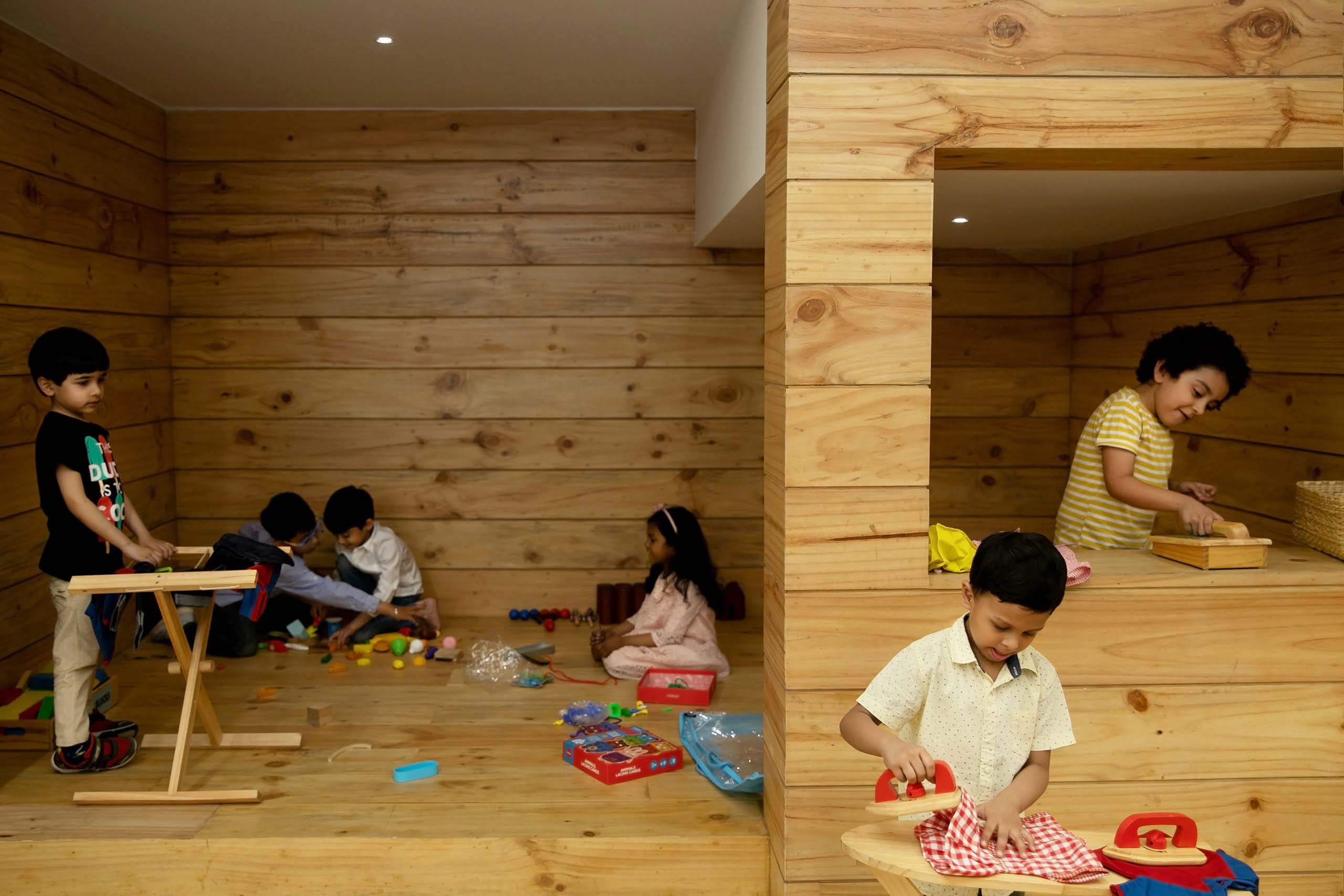
There is a moment many parents describe after their first visit to a Reggio Emilia classroom. They walked in with something practical on their mind – timings, perhaps, or how assessments work – and then stopped. Because the room they were standing in looked nothing like any classroom they had been in before. And the child at the light table, arranging stones and leaves with quiet concentration, looked nothing like someone who was simply playing.
She was not simply playing.
That is the insight at the heart of early years education done well. The play is the learning. The arrangement of the room is the curriculum. The teacher sitting nearby, watching, asking an occasional question – that is not supervision. That is teaching.
At Heritage International Xperiential School in Gurgaon, the Early Years programme is built on exactly this understanding. HIXS is among the IB schools in Gurgaon that take this foundational stage seriously – not as a warm-up to real school, but as learning in its most essential form. Not as a philosophy printed on a wall, but as something visible and felt the moment you walk through the door.
The Reggio Emilia Approach at HIXS
The Reggio Emilia approach was born in northern Italy in the years after World War Two – a community of parents and educators who decided, together, that children deserved something better than passive, instruction-heavy schooling. What they created became one of the most respected early childhood frameworks in the world.
The idea at its centre is simple: children are not empty vessels waiting to be filled. They arrive at school already curious, already capable, already making sense of the world in their own way. A school’s role is not to override that process but to support it.
HIXS took this seriously when designing its Early Years programme – not as an aesthetic choice, though the spaces are genuinely beautiful, but as a fundamental shift in how educators relate to young children.
The Environment as the Third Teacher
In Reggio Emilia thinking, the classroom itself is considered a teacher. How a space is arranged, what materials are available, whether there is room for movement or quiet – all of it communicates something to a child about what is possible here, and what they are trusted to do.
In the Early Years spaces at HIXS, this is immediately visible. Natural materials and open-ended objects sit alongside spaces designed for both mess and stillness. The walls carry documentation of children’s thinking – not as decoration, but as a living record of ideas in progress.
As one of the few schools with IB curriculum that roots its earliest years in Reggio Emilia thinking, HIXS creates a continuum of inquiry-based learning from the very start. The IB School Syllabus at HIXS is structured so that the habits of mind developed in Early Years – curiosity, reflection, collaboration – carry forward into the Primary Years Programme and beyond.
A Hundred Ways of Knowing
Loris Malaguzzi, the founder of the Reggio Emilia approach, spoke of the hundred languages of children – the idea that young children understand and express the world through movement, drawing, building, music, dramatic play, storytelling, light and shadow. And that most schooling chooses to value only two or three of those languages.
At HIXS, this is taken seriously in practice. A child who thinks through movement is not asked to sit still as a precondition for learning. A child who processes the world by building things is given materials, time, and space. Assessment in the Early Years is observational – teachers watch what children do, document it carefully, and use that knowledge to plan the next step.
What this means is that children at age three or four are not being sorted or ranked. They are being known – individually, carefully, and deeply. Among IB Board Schools in Gurgaon, that kind of early attention is rarer than it should be.
Starting School: A Transition Built Around the Child
For most children, starting school is the first significant separation from home. How that transition is handled matters – not just in the first week, but in how a child comes to understand whether school is a place where they are safe to be themselves.
At HIXS, the settling-in process is gradual and led by the child’s own readiness. Families are brought into the process early and kept genuinely involved – not managed at a distance, but treated as people who know their child far better than any school can in those first weeks.
A child who trusts their teacher will take risks, ask questions, and try things that feel uncertain. A child who does not will spend that energy elsewhere.
Among the Top IB Schools in Gurgaon, HIXS stands apart in how it treats the Early Years not as preparation for serious learning, but as serious learning itself. The Top IB Schools understand that what happens at age three shapes the learner a child becomes at thirteen. At HIXS, that understanding is visible in every corner of the classroom.
Frequently Asked Questions
Q1. What is the Reggio Emilia approach and how is it different from other early years programmes? The Reggio Emilia approach treats children as capable, curious learners from the start. Rather than following a fixed syllabus, it allows children’s questions and interests to guide learning. At HIXS – one of the few early years schools in Gurgaon with this framework – this means no worksheets, no rote tasks, and no single correct answer.
Q2. Is the Early Years programme at HIXS connected to the IB curriculum? Yes. HIXS is a Best IB School in Gurgaon offering a full continuum from Early Years through the IB Primary Years Programme (PYP) and beyond. The inquiry habits formed in Early Years align directly with what the IB framework builds on in later years.
Q3. How does HIXS support children during the transition from home to school? The settling-in process at HIXS is gradual and child-led. Families are involved from the beginning – as genuine partners, not observers. The school gives each child the time and space to find their footing at their own pace.
Q4. How is progress assessed in the Early Years at HIXS? Assessment is entirely observational. Teachers document what children do, say, build, and create – then use that knowledge to plan next steps. There are no tests or rankings. The goal is to understand each child deeply, not to compare them.
Q5. How do I begin the admission process at HIXS? Families interested in IB School Admission in Gurgaon can start the process through the HIXS admissions page. The team is available to answer questions, arrange a campus visit, and walk you through each stage of IB School Admission.
Conclusion
What Heritage International Xperiential School is building in its earliest years is not complicated to describe. It is a place where young children feel known, feel safe, and feel free to be genuinely curious. Where the room itself is designed to teach. Where a teacher’s most important skill is knowing when not to speak.
If you are exploring IB schools in Gurgaon for your child’s foundational years, this is a programme worth seeing in person. Take a walk through those classrooms. You will understand immediately.


